
Methods and meaning
To be able to evaluate my photography I have to consciously look what drives my life as a whole and religion is one of my core values. I am Baptist minister that through the years specialized as a social worker and community developer working in poor and restricted Christian communities around the world now for almost 20 years. In the last decade I have been residing in the Middle East and focusing more specifically on working with displaced minorities.
Looking back at my portfolio, I rediscovered myself and learned how for many years my photography is being marked by a constant concept: a desire to capture and reveal the magnitude of the social need of the people groups and places I am working during that specific time of my life.
Method x Methodological Process
Reviewing my photography process, I could identify four stages: a) research; b) planning; c) capture; and d) output.
RESEARCH: Before visiting a country to start the projects I was assigned to, I would always dive deep on its history, politics, and economics and mainly on all available knowledge on persecution and restrictions imposed on the minorities I would be serving, always giving a special attention to how Christians are treated in that specific place.
PLANNING: I never planned my pictures or created sets and backgrounds or even mandatorily organized my subjects on a scenery. However, my photography has a general trend that can be easily tracked because of the concept I always wanted to achieve. Today I can see my compositions are filled with similarities like: crossing lines, high contrast between subjects and backgrounds, depth and separation between subjects and backgrounds, deep emotional facial expressions, constant use of Black and White trying to create a timeless feeling on the image (for both my digital or analog photography), contrast between high human populated images with very intimate portraits, contrast of feelings on subjects (sometimes gathering happy subjects with others that are very sad), lots of police and governmental buildings and lots of poor houses with very simple structures, etc.
CAPTURE: I always thought I should capture images with whatever I would have available at the time. So, until a few years ago (2018), most of my equipment would not even be considered professional from many people. I took pictures with analog cameras, small digicams, phones and various DSLRs, until I established myself in the mirrorless world. My trips would lengh sometimes for weeks other times for months and they became the perfect moment to explore and capture my images.
OUTPUT: During the initial 10 years of my photography, I worked for an international organization that had a monthly magazine and all sort of social media platforms. One of my responsibilities was to write and publish articles and news about the places they had projects being developed, so I had a constant output for my photography as well as writing. Many of my images were used all over the world by their counter-part offices spread in different countries where they would fundraise and mobilize like they were doing in Brazil, which is my homeland and where the office that I was working for was based.
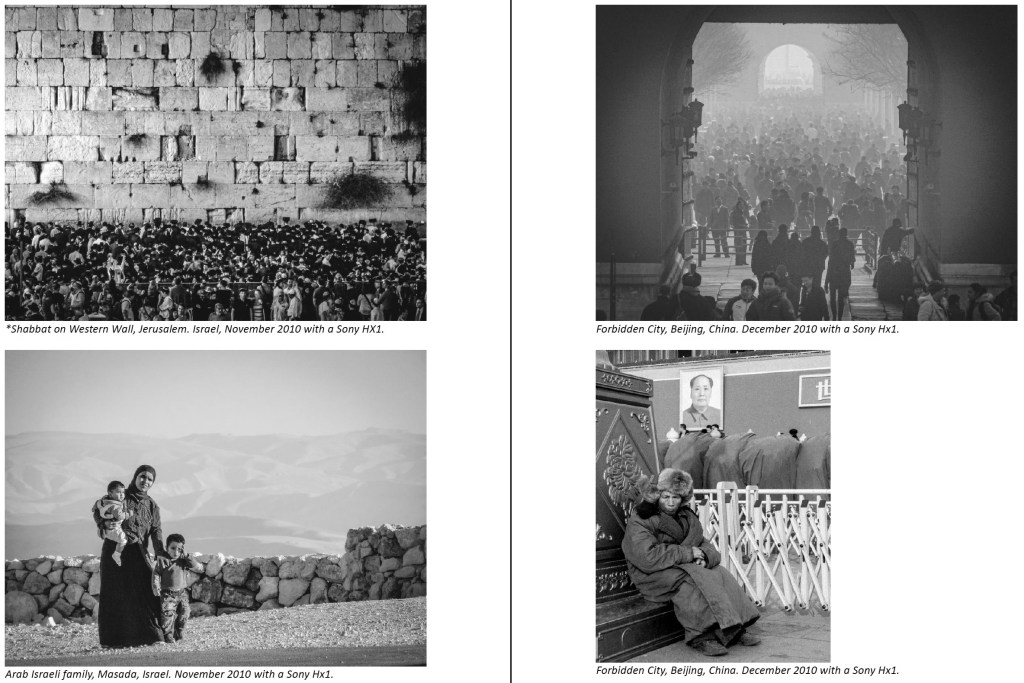
Considering the images presented in the beginning of this text, the methodological process that was above described was applied. Either in Israel or in China, it’s very easy for the viewer to identify the religious concept and the social need of the presented groups, especially when these photographs are used in the context of an article that explains the persecution that Christian minorities face in both contexts. Messianic Jews are severely persecuted by Orthodox and Ultra-Orthodox in Israel, as Chinese Christians face daily restrictions, monitoring, control, and constant oppression from the Communist authorities.
 Homero Aziz